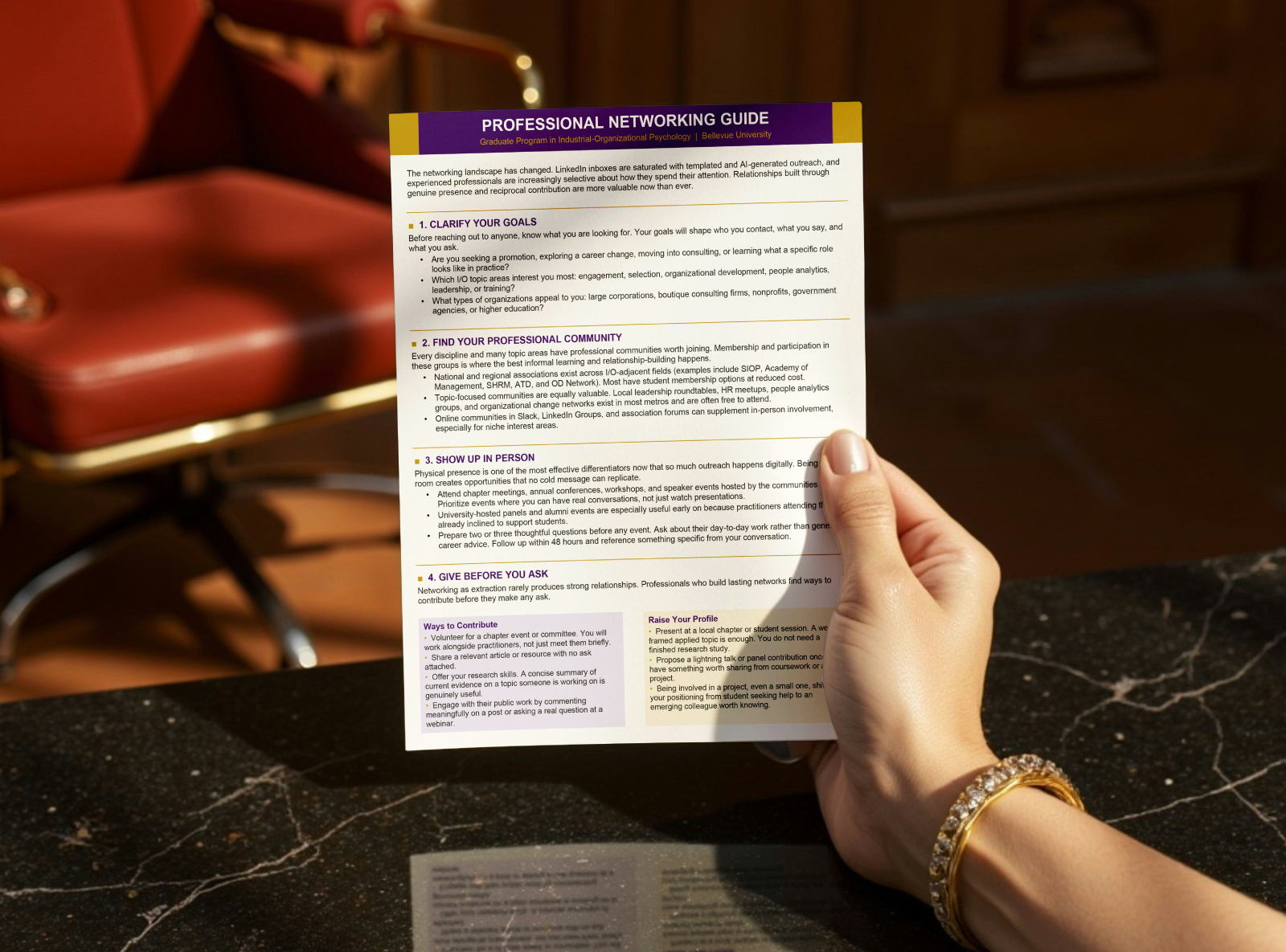
Professional Networking Guide 2026
The networking landscape has changed. LinkedIn inboxes are saturated with templated and AI-generated outreach, and experienced professionals are increasingly selective about how they spend their attention. Relationships built through genuine presence and reciprocal contribution are more valuable now than ever.
1. Clarify Your Goals
Before reaching out to anyone, know what you are looking for. Your goals will shape who you contact, what you say, and what you ask.
• Are you seeking a promotion, exploring a career change, moving into consulting, or learning what a specific role looks like in practice?
• Which I/O topic areas interest you most: engagement, selection, organizational development, people analytics, leadership, or training?
• What types of organizations appeal to you: large corporations, boutique consulting firms, nonprofits, government agencies, or higher education?
2. Find Your Professional Community
Every discipline and many topic areas have professional communities worth joining. Membership and participation in these groups is where the best informal learning and relationship-building happens.
• National and regional associations exist across I/O-adjacent fields (examples include SIOP, Academy of Management, SHRM, ATD, and OD Network). Most have student membership options at reduced cost.
• Topic-focused communities are equally valuable. Local leadership roundtables, HR meetups, people analytics groups, and organizational change networks exist in most metros and are often free to attend.
• Online communities in Slack, LinkedIn Groups, and association forums can supplement in-person involvement, especially for niche interest areas.
3. Show up in Person
Physical presence is one of the most effective differentiators now that so much outreach happens digitally. Being in the room creates opportunities that no cold message can replicate.
• Attend chapter meetings, annual conferences, workshops, and speaker events hosted by the communities you join. Prioritize events where you can have real conversations, not just watch presentations.
• University-hosted panels and alumni events are especially useful early on because practitioners attending them are already inclined to support students.
• Prepare two or three thoughtful questions before any event. Ask about their day-to-day work rather than generic career advice. Follow up within 48 hours and reference something specific from your conversation.
4. Give Before You Ask
Networking as extraction rarely produces strong relationships. Professionals who build lasting networks find ways to contribute before they make any ask.
|
Ways to Contribute • Volunteer for a chapter event or committee. You will work alongside practitioners, not just meet them briefly. • Share a relevant article or resource with no ask attached. • Offer your research skills. A concise summary of current evidence on a topic someone is working on is genuinely useful. • Engage with their public work by commenting meaningfully on a post or asking a real question at a webinar. |
|
Raise Your Profile • Present at a local chapter or student session. A well-framed applied topic is enough. You do not need a finished research study. • Propose a lightning talk or panel contribution once you have something worth sharing from coursework or a project. • Being involved in a project, even a small one, shifts your positioning from student seeking help to an emerging colleague worth knowing. |
5. COLD OUTREACH THAT ACTUALLY WORKS
Cold outreach is harder than it used to be. Standing out requires brevity, genuine personalization, and a clear signal that you did real research.
• Reference something specific: a talk they gave, an article they wrote, or a project you found on their organization’s website. This cannot be faked.
• If emailing, use your Bellevue University email address. Institutional addresses are more credible than personal ones and validate your identity as a current student.
• Make a single, bounded ask. Asking for a 20-minute conversation about a specific topic is far more likely to receive a yes than a vague request to connect or chat.
• Keep the message to three short paragraphs or fewer. Acknowledge their time is limited. Do not use AI-generated templates without heavy personalization; practitioners recognize them immediately.
6. MAINTAIN RELATIONSHIPS OVER TIME
A network is not a contacts list. It requires tending between asks and the onus is on you as the student to be proactive and prepared.
• Send a brief thank-you after any conversation that references something specific you took away from it.
• Be considerate of their time, providing ample time for responses if you are scheduling a meeting. You are responsible for sending calendar invites and providing any materials in advance of the meeting.
• Share relevant resources, note milestones, and provide updates on your progress without attaching a request.
• Look for concrete ways to return value: building on their conversations, sharing relevant research, attending sessions live, etc.